
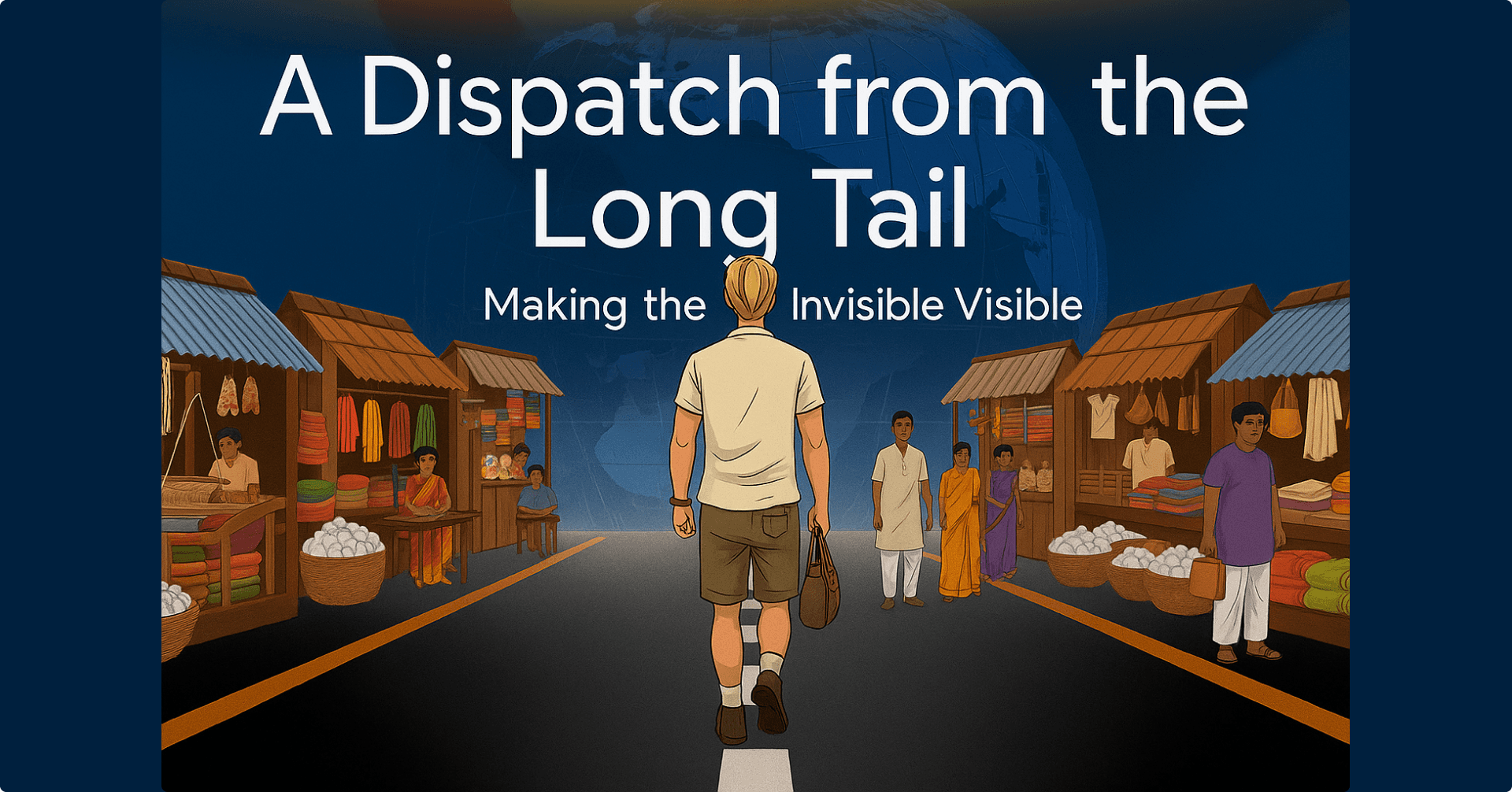
In Karur, a small city in Tamil Nadu, cotton has been processed for export for decades. Walk down a narrow lane and you’ll find family workshops stitching table linens for Zara Home and Williams Sonoma. Their names don’t appear on the labels, yet their work travels to restaurants in Paris and hotels in Dubai. However, Karur is not unique; it is one of thousands of industrial clusters across India where skill and craft are largely invisible, rarely counted, yet capable of world-class output.
Most of these producers remain hidden behind layers of middlemen, logistics hurdles, and licenses. They survive but rarely thrive, not for lack of ambition, but for lack of access: to finance, predictable freight tariffs, and reliable digital rails that would let them sell directly. The long tail of Indian enterprise has been largely obscured, waiting to be unlocked.
Conversations about India’s economic rise often circle the same familiar terrain: IT services, a handful of consumer brands, and the unicorn startup club. But that’s a very narrow slice of the story. The countless small and midsize exporters who actually make and move things are where the real energy lies. They’ve built for global buyers for decades but remain trapped in a system designed to get by, not to grow. What they need isn’t to work harder, it’s the infrastructure to ship across borders, settle payments, prove compliance, surface their catalogs at scale, and be trusted by buyers thousands of miles away.
This is the part of the economy I care about most, and it’s where Xindus, the company I’ve been helping to build, focuses. Our mission is to lay the rails for businesses too small to own departments for compliance, shipping, or direct selling, yet too skilled to remain local forever. It’s about connecting them to global demand with speed, trust, and technology.
If India is to become an export powerhouse, it won’t be because a few mega-factories in Gujarat or Tamil Nadu grow larger. It will happen when the fragmented long tail gains a fair shot at scale. Large exporters are easier to count, but they are also easier to disrupt. A distributed base of small producers is what makes an economy shock-proof, just as distributed talent made India’s IT sector resilient through global crises. It’s time to do for manufactured goods what Infosys and Wipro once did for services.
The timing is right. Buyers everywhere are looking for alternatives to China. The “China + 1” idea is no longer theory; supply-chain managers in the US, Europe, and Japan are actively diversifying. India should be the obvious answer, yet the experience of buying from India remains unnecessarily difficult, rife with fragmented suppliers, unpredictable paperwork, and unreliable lead times.
We’ve seen what happens when barriers are lifted. At Xindus we’ve moved shipments from towns most global buyers have never heard of and cleared them seamlessly into the US, Latin America, the Gulf, and Europe. When a small manufacturer gains direct market access, pricing improves, cash cycles shorten, and reinvestment follows. Trust builds quickly once the first transaction goes smoothly—a buyer who once said “India’s too messy” soon says “Let’s double the order next season.”
Technology is the lever, but not the whole story as software alone doesn’t move goods. The real challenge is building a trade stack that fuses physical movement with digital certainty encompassing freight, compliance, duties, payments, and credit priced for reality rather than risk stereotypes. Much of our time goes into fixing the small frictions that erode trust: a missing document, a customs delay, a misrouted container.
Supporting this segment also means telling a truer story about India. The national narrative too often lives in abstractions; a billion consumers, a demographic dividend, digital adoption. Those matter, but they obscure the lived reality of the people who actually produce. The owners of small workshops and looms don’t see themselves as part of a grand thesis. They think about getting paid fairly and on time, about their children’s education, and about the next order. They are not symbols of entrepreneurship and helping them isn’t charity. An India whose long tail sells globally will be richer, more resilient, and more innovative, creating jobs in the very towns that need them most.
It’s also a way to rewrite globalization itself. When a buyer in New York places an order for linen, they’re not just purchasing fabric; they’re engaging with a lineage of design and craft that carries local identity outward. When copperware from Pune or toys from Channapatna reach a foreign shelf, a rich heritage crosses borders. The world gains diversity while India gains prosperity. Xindus itself takes its name from the idea of crossing the Indus—the ancient frontier between civilizations and the original artery of trade. We build the digital rails for modern commerce, connecting India’s makers and exporters with the world through trust, compliance, and technology.
For me, this is personal. I’ve spent years moving through India’s markets and workshops, fascinated by the intelligence that doesn’t always translate outside the country. That intelligence has always been there, it simply lacked modern rails. Building those rails is why Xindus exists.
We have a long way to go, but each time a new buyer takes a chance on a small Indian exporter, a little more of that hidden capacity comes into view. Every success chips away at the notion that India is too hard or too risky, moving us closer to an economy where opportunity isn’t decided by proximity to a port or a bank branch.
When the long tail begins to move, it pulls the whole country forward.

